Long-Horizon Investing as a Discipline
Long-horizon investing isn't a forecast — it's a repeatable decision process. A calmer, source-backed framework anchored in how the SEC and FINRA actually describe time horizon, compounding, fees, diversification, and risk.
By CoinSail Editorial
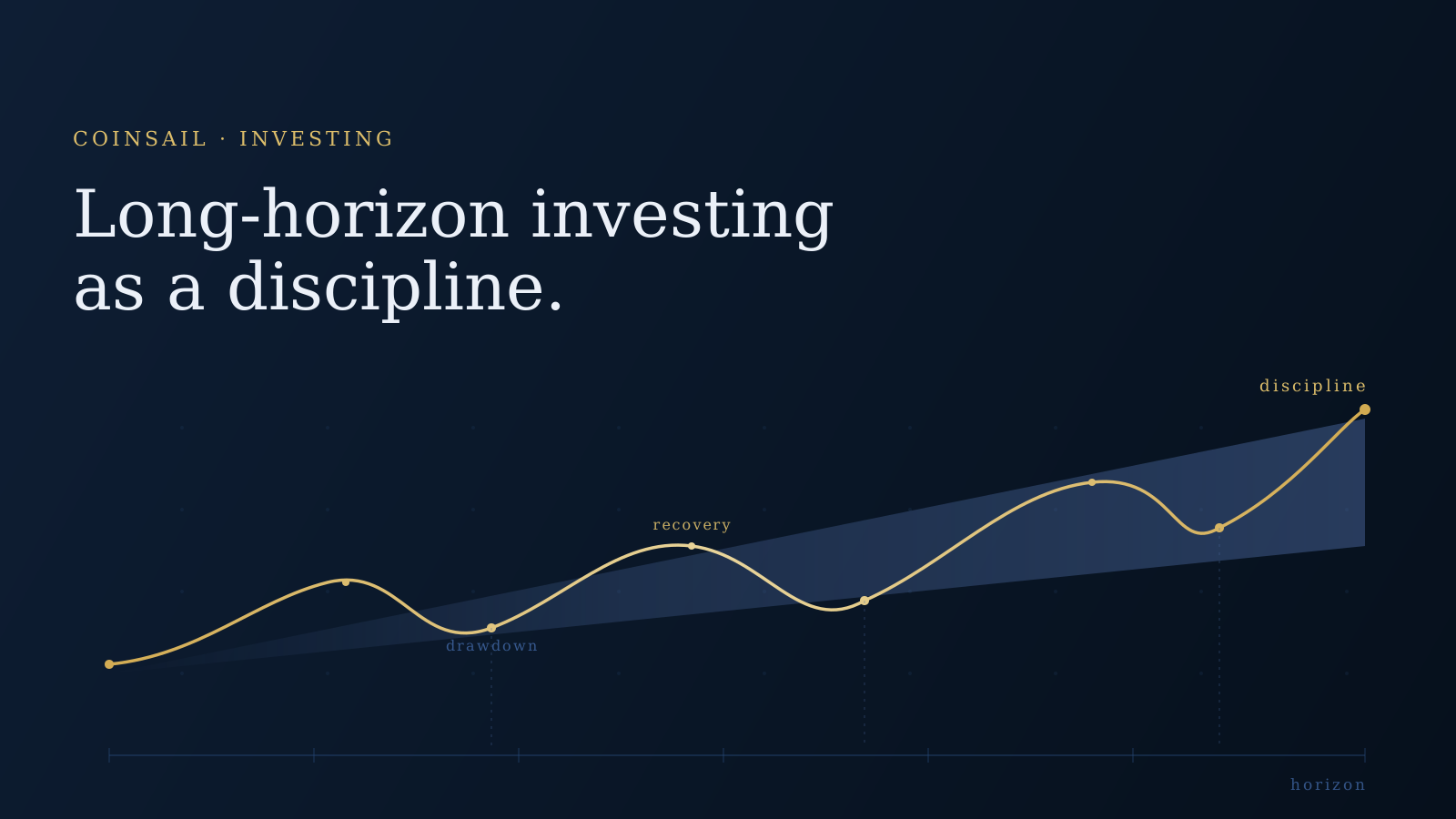
"Invest for the long term" is one of the most repeated, least examined slogans in personal finance. Treat it as a discipline — a small set of repeatable decisions held across years and drawdowns — and it becomes one of the most useful frames an independent investor can have. Treat it as a slogan, and it quietly turns into a promise that nothing should ever feel uncomfortable. Markets are happy to remind you, on a regular schedule, that the promise was never the deal.
This article is the discipline version. Where possible, it's anchored in how the U.S. Securities and Exchange Commission's investor-education office and FINRA — the U.S. broker-dealer regulator — actually describe time horizon, compounding, fees, diversification, and risk. It is educational; it is not personalised investment advice.
What long-horizon investing actually means
The clean definition starts with time horizon. The SEC's Office of Investor Education and Advocacy defines it plainly: time horizon is "the number of months, years, or decades you plan to invest to achieve your financial goal." Long-horizon investing is therefore not a personality type — it's a decision parameter set by what you're investing for and when you'll need it.
That parameter changes the question you're asking. With a one-year horizon, the question is roughly "how do I avoid a bad twelve months?" — which is dominated by drawdown management and liquidity. With a twenty- or thirty-year horizon, the question is closer to "what is the smallest set of disciplined choices I can hold through whatever happens?" The SEC frames the implication permissively rather than prescriptively: "Investors with a longer time horizon may feel comfortable taking on riskier or more volatile investments." The word may is doing real work — circumstance, not slogan, is what permits more risk.
Why time horizon changes the decision process
A long horizon doesn't make markets predictable. It changes what you can reasonably ask of them.
It's important to be honest about what time doesn't do. FINRA is unusually direct about this in its investor-education materials on risk: "stocks are always risky investments, even over the long-term. They don't get safer the longer you hold them." And: "the historical data should not mislead investors into thinking that there is no risk in investing in stocks over a long period of time." That's a regulator stating the anti-claim plainly. The long horizon is not a safety net. It's an interval over which a disciplined process can be applied — and inside which volatility and drawdowns are still real, just spread out across more time.
The reason a long horizon is useful isn't that risk disappears; it's that it gives a disciplined process room to operate. Which brings us to the mechanisms.
Compounding — what it is, what it doesn't promise
The SEC's classroom explainer puts compound interest in one line: "interest you earn on interest." Its worked example uses a single $100 deposit at 5% per year. After year one, you have $105. After year two, you have $110.25. Twenty-five cents may sound small — but the SEC's own framing makes the long-horizon point explicit: even with no further contributions, "in 10 years you'll have more than $162 thanks to the power of compound interest, and in 25 years you'll have almost $340."
That's the mechanism: not just earning on principal, but earning on earnings. It's also, critically, a mechanism — not a forecast. Compounding doesn't pick which return compounds, and it doesn't pick the path. The actual long-horizon outcome depends on the realised return, the fees you pay, and how you behave during the periods when the curve goes the wrong way. The mechanism is symmetric: losses can compound against you over short windows in exactly the way returns compound for you over long ones.
So the right way to read compounding is as the reward for staying invested through uncertainty — not as a promise that staying invested guarantees a particular endpoint.
Costs, fees, and turnover
If compounding rewards staying invested, fees punish the same patience by the same mechanism. They're a return that flows the wrong way, year after year.
The SEC's investor bulletin on how fees affect a portfolio puts numbers on this with a clean dated example: a $100,000 investment growing at 4% annually over 20 years would be worth approximately $208,000 at a 0.25% annual fee, approximately $198,000 at a 0.50% fee, and approximately $179,000 at a 1.00% fee. The same starting balance, the same gross return, the same horizon — and roughly $29,000 separating the lowest-fee outcome from the highest. That's compounding running in the opposite direction.
The discipline implication is concrete and unglamorous: know what you pay. Expense ratios, trading costs, advisory fees, account fees, and turnover-driven taxes all compound the same way. They don't have to be zero — but they have to be priced.
Diversification — what it does and doesn't do
Diversification is the most-quoted and most-misused word in retail investing. The cleanest distinction comes from FINRA: "Asset allocation is the equivalent of deciding how many of your eggs you're going to put into how many different baskets — or asset classes. Diversification is the spreading of your investments both among and within different asset classes."
Two different decisions, stacked:
- Asset allocation — how you divide between categories (stocks, bonds, cash, and so on).
- Diversification — how you spread within and across those categories.
The honest description of what diversification accomplishes is also a regulator-supplied caveat. FINRA frames diversification as a way to "manage" risk — explicitly to "reduce your risk if an individual security or sector doesn't perform well." That's reduction, not elimination. The SEC and FINRA both stop short of claiming diversification removes the risk of loss; the spread reduces certain concentrated risks while leaving market-wide risk intact.
Volatility, drawdowns, and behaviour
Markets, in FINRA's own short line, "can be volatile — in other words, they can go up and down — and every investment carries some risk." The hard part of long-horizon investing isn't the strategy on paper. It's the behaviour during the years and quarters when the strategy is losing money and the news is loud.
A few things are worth being honest about up front:
- Drawdowns will happen inside any long-horizon portfolio. They are not failures of the framework. They are the conditions under which the framework is supposed to operate.
- Behaviour during drawdowns is part of the framework, not separate from it. A long-horizon allocation that gets liquidated mid-decline is, in practice, no longer a long-horizon allocation.
- Risk and expected reward tend to track together. Per FINRA, "the level of risk associated with a particular investment or asset class typically correlates with the level of return the investment might achieve." Higher expected returns generally come bundled with higher risk — including deeper drawdowns — and that bundle is the part discipline has to absorb.
The single most useful planning step here is to decide what you'll do during the next drawdown before it arrives — and to write that decision down somewhere you'll have to overrule on purpose.
A practical long-horizon checklist
Six questions a reader can revisit on a schedule (annually is plenty; quarterly is fine):
- Is your horizon clearly stated? For this money, in years.
- Is your asset allocation deliberate? Categories chosen on purpose, not by accumulation.
- Is there real diversification within each category? Spread that survives a bad sector, not just a name.
- Do you know what you're paying? Each holding's expense ratio; advisory fees; trading and tax costs. Use FINRA's Fund Analyzer or equivalent for the maths.
- Is there a review cadence written down? A calendar entry that forces the question, not a vibe.
- Do you have an advance plan for the next drawdown? Defined before stress, not during it.
None of these questions try to predict anything. They make the decision process auditable — which is what "discipline" actually means.
Common mistakes
A handful of failure modes show up repeatedly:
- Treating "long term" as a guarantee. FINRA's anti-claim is explicit: longer holding periods do not make stocks safer. Time changes the question you're asking, not the answer the market provides.
- Confusing diversification with asset allocation. They are different decisions. Owning thirty stocks in the same sector is concentration, not diversification.
- Ignoring fees. The SEC's own worked example shows the dollar magnitude. Fees are the most controllable input in the entire framework.
- Reading historical averages as forward returns. Past patterns are context, not forecasts. Treat published return numbers as descriptive, not predictive.
- Abandoning the plan during drawdowns. The most expensive long-horizon decision is usually made under stress and confirmed by a feed.
Risks and limitations
Three honest limits worth keeping visible:
- Risk is irreducible. Diversification manages, allocation arranges, time spreads — none of those eliminate the possibility of loss. FINRA states the baseline plainly: "every investment carries some risk."
- This is educational, not personal investment advice. Allocation, fee tolerance, drawdown capacity, and time horizon are personal. The framework is the same; the answers are not.
- A framework cannot substitute for circumstances. Liquidity needs, taxes, income stability, debt, and life events all shape what counts as a sensible long-horizon decision. The discipline is consistent; its application is specific.
Bottom line
Long-horizon investing is a discipline because it asks you to act consistently across uncertainty. You pick a horizon, decide how to allocate, diversify within each allocation, mind costs, and write down in advance what you'll do during the next drawdown. The framework is the auditable part. The outcome is not.
Done that way, "invest for the long term" stops being a slogan and starts being a process. The slogan promises something the market never promised; the process commits to behaviour you actually control.
Sources used
- SEC Investor.gov — Asset Allocation and Diversification — definitions of time horizon, asset allocation, and diversification, plus the permissive framing that longer horizons may support more volatile investments.
- SEC Investor.gov — What is compound interest? — the canonical $100 → $105 → $110.25 worked example and the explicit "in 10 years more than $162, in 25 years almost $340" long-horizon framing.
- FINRA — Asset Allocation and Diversification — the distinction between asset allocation (which baskets) and diversification (spreading among and within baskets).
- FINRA — Risk — the explicit caveat that stocks don't get safer the longer you hold them, the systemic-versus-non-systemic-risk framing, and the risk-reward correlation.
- SEC Investor.gov — How Fees and Expenses Affect Your Investment Portfolio — the dated $100,000 / 4% / 20-year worked example of how a fraction of a percentage point of annual fees changes the ending dollar value.
- FINRA — Financial Tips for New Investors — the explicit "markets can be volatile … every investment carries some risk" framing and the role of risk tolerance.
"Long-horizon investing is a discipline because it asks you to act consistently across uncertainty. The framework is the auditable part; the outcome is not."
More in this category
Crypto as a Position, Not an Identity
Treat crypto exposure as a position with a thesis, a size, a custody plan, and an exit — not as an identity that survives every drawdown. A calmer, source-backed framework anchored in how the SEC, FINRA, and CFTC describe the real risks.
10 min read · CoinSail Editorial