The Trading Journal That Actually Works
A trading journal is a review system, not a profit engine. A calmer, source-backed framework for what to record before, during, and after a trade — anchored in the SEC and FINRA's own framing of recurring investor mistakes.
By CoinSail Editorial
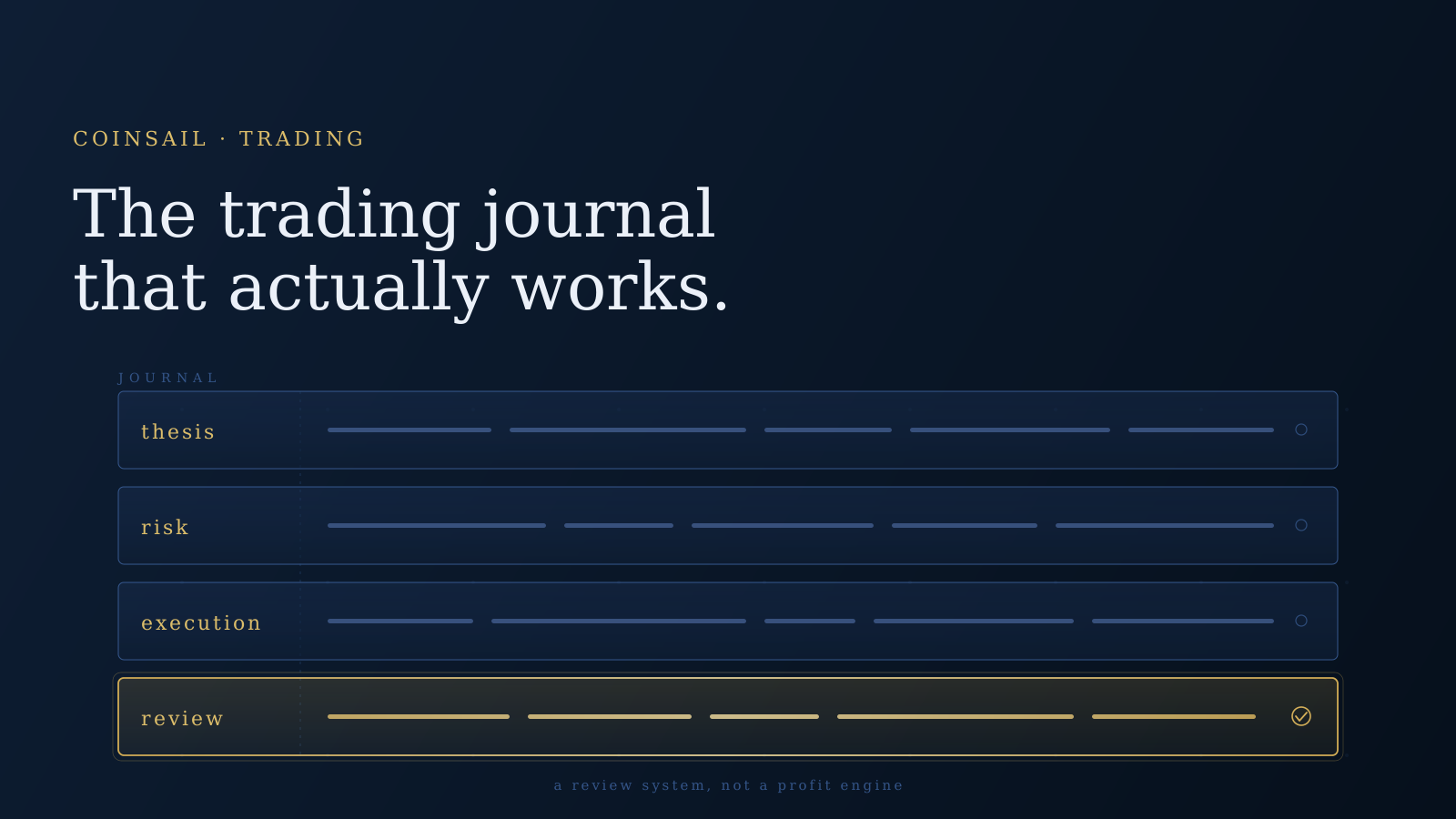
Most trading journals fail in one of two ways. They get abandoned after a month because logging trades feels like homework, or they get misused — turned into after-the-fact justifications, win-only highlight reels, or confidence props for whatever the trader wanted to believe anyway.
The journal that actually works is none of those things. It's a review system — a structured way to make decisions auditable to you, after the fact, against the criteria you set before the fact. The SEC's Office of Investor Education and Advocacy frames the problem it solves directly: investors repeatedly fall into the trap of "making the same investment mistakes over and over again." A journal is the most defensible way to detect that pattern in your own behaviour.
This article is the process version. It's anchored where possible in how the SEC and FINRA actually describe recurring investor mistakes, short-term trading risk, and the willing-versus-able framing of risk tolerance. It is educational; it is not personalised trading advice; and it explicitly avoids the "journal your way to profits" framing.
What a trading journal is actually for
A useful journal does three things, all of them retrospective rather than predictive:
- It surfaces the recurring patterns regulators warn about. The SEC's investor bulletin on the behavioural patterns of U.S. investors names nine specific ones, including active trading, the disposition effect (defined by the SEC as "the tendency of an investor to hold on to losing investments too long and sell winning investments too soon"), momentum investing, noise trading, and inadequate diversification. None of these are visible from a single trade. All of them are visible from twenty.
- It separates the quality of the decision from the quality of the outcome. Markets are noisy enough that a good decision can lose money and a bad decision can make money. Without a journal, the only feedback a trader has is the P&L — and the P&L lies about what actually worked.
- It exposes the gap between the risk you're willing to take and the risk you can actually take. FINRA frames this distinction explicitly: "Being willing and able to take on a certain amount of risk are two different things, and you must make sure the risk you're willing to take is consistent with the level of risk you're actually able to take." A journal is where that gap shows up — in position sizes that creep, plans that get overridden, and state notes that show stress.
None of those three jobs is "make the trader more profitable." A journal makes the trader more legible to themselves — and the rest is up to discipline, risk capacity, and what the market is willing to do.
What to record before the trade
The before-trade entry is the most important part of a journal, because it's the only part that can't be revised in your favour later. Six fields cover most of what matters:
- Thesis. Why this position, in plain language. If "everyone's bullish" or "it feels like it should bounce" is the strongest version of the thesis, that's worth noting too — and worth honestly labelling.
- Invalidation criterion. What would make the thesis wrong, written before it happens. "Below this level" is a price-based answer. "If earnings miss on revenue more than X" is a fundamentals-based answer. "If the catalyst doesn't materialise by Friday" is a thesis-based answer. The shape doesn't matter; what matters is that you set it before, not after.
- Position size, in % of capital at risk. Not in shares. Not in dollars. The percentage you would lose if the invalidation criterion is hit. This is the most useful number in the entire journal.
- Entry plan. Price level or condition, timing, and whether the order is at-market, limit, or staged.
- Exit plan. Price-based, time-based, or thesis-based — the same shape as invalidation, but on the upside.
- State. Two lines. How am I? (tired, anxious, revenge-trading after a loss, distracted, overconfident from a recent win?) The honest version, written before opening the position. This field will save more money than any of the others over time.
If any of these six fields can't be filled in honestly before the position opens, that itself is a signal — the position isn't ready, the journal is.
What to record during and after the trade
The after-trade entry should be short. It is not a place to retell the story or justify what happened. Three fields:
- What happened versus the plan. Did you hit the entry price? Hold the stop? Adjust mid-trade? "Held to plan" is a complete entry. "Moved stop down twice" is also a complete entry — and a much more useful one.
- Surprises. Anything that happened that wasn't in your model. News, gap, illiquidity, slippage, an emotional impulse you noticed and (didn't / did) act on.
- Outcome. P&L, in % of capital, and a one-line note on whether the outcome was consistent with the plan or independent of it. The P&L number matters less than that line. We'll come back to why in the next section.
Separating process quality from outcome
A useful journal forces a four-cell sort across every closed trade:
| Good outcome | Bad outcome | |
|---|---|---|
| Good process | Skill — or luck. Note which. | Risk worked as intended; the loss was the cost of doing business. |
| Bad process | Most dangerous cell. Reinforces what shouldn't be reinforced. | The rare easy lesson. |
The SEC's investor alert on short-term trading puts a fence around this: "Short-term investing in a volatile market carries significant risk of loss." A journal doesn't argue with that statement. It accepts it as the operating environment and tries to figure out which side of the matrix any given trade actually belonged in.
The dangerous cell — bad process, good outcome — is where most informal trading careers stall. The trade made money, so the trader concludes the process was fine, repeats it, and watches the next ten trades hand the money back. The SEC's separate framing of "noise trading" applies precisely here: noise trading occurs "when an investor makes a decision to buy or sell an investment without the use of fundamental data," and noise traders "generally have poor timing, follow trends, and overreact to good and bad news." A journal is how a trader catches their own noise trading — not in the moment, but in the week-over-week review.
Weekly / monthly review
The review is where the journal stops being a log and starts being a process. Two cadences are enough for most readers:
- Weekly. Read every closed trade from the past week. Sort each one into the four-cell matrix above. Note the category of any patterns: are you sizing larger after a win? Holding losers longer? Overriding your invalidation criterion? Trading more on days when your "state" field flagged anxiety or boredom? These are the SEC's named behavioural patterns showing up in your own data.
- Monthly. Step back from individual trades. Count how often you stuck to your plan versus overrode it. Compare your willing risk tolerance (what you said in advance you could handle) against the able risk tolerance the data shows (what your account actually survived without forcing emotion-driven decisions). FINRA's four-factor frame — objectives, time horizon, reliance on funds, inherent personality — is the cleanest checklist for that gap.
The review should produce written takeaways, not vibes. One concrete adjustment per month is plenty.
A practical journal template
The structure matters more than the medium. A spreadsheet works. A notebook works. A note-taking app works. What matters is that every row has these fields and that they get filled in honestly:
| Field | Before / After | What it captures |
|---|---|---|
| Date / instrument | Before | When and what (no need for specific ticker mentions here — just the class is enough) |
| Thesis | Before | One or two sentences, plain language |
| Invalidation | Before | What would make the thesis wrong |
| Size (% of capital at risk) | Before | The percentage, not the dollars |
| Entry plan | Before | Level, timing, order type |
| Exit plan | Before | Level, timing, condition |
| State | Before | Honest line about how you are |
| What happened vs plan | After | Adherence, deviations, slippage |
| Surprises | After | Anything not in the model |
| Outcome (% of capital) | After | And one line on whether it tracked the plan |
| Process / outcome cell | Review | Which of the four cells the trade belonged in |
| Pattern noted | Review | Which SEC-named behaviour (if any) showed up |
That's it. No fancy app required. No specific platform endorsed.
Common mistakes
A few failure modes show up repeatedly:
- Treating P&L as the only review signal. The journal exists because P&L on its own is misleading.
- Journaling only the wins. A journal that's missing losses is a confidence prop, not a record.
- Skipping the state field. "Tired and angry" is among the most predictive entries a journal can carry. Leaving it out hides exactly what you need to see.
- Letting the journal become an after-the-fact justification. The before-trade entries are the audit trail. If they're filled in after the trade, the journal is no longer a journal.
- Reviewing without writing down what changed. A review with no written takeaway is a review you'll be repeating next month, unchanged.
Risks and limitations
A few honest limits worth keeping visible:
- A journal does not eliminate risk. FINRA's framing on day trading specifically is unambiguous: "Day trading generally isn't appropriate for someone of limited resources, limited investment or trading experience and low risk tolerance. A day trader should be prepared to lose all of the funds used for day trading." FINRA is equally clear about what shouldn't fund any speculative trading: retirement savings, student loans, second mortgages, emergency funds, education or housing money, and money required to meet living expenses. The journal is not a license to ignore any of that.
- A journal does not create edge. Nothing in the cited regulator material endorses a "journaling leads to profits" claim, and neither does this article. Journaling helps you learn from your own decisions; the market is under no obligation to reward that learning.
- This article is educational, not personalised trading advice. What you trade, how often, at what size, and whether short-term trading suits your circumstances at all are personal questions. The framework is the same; the answers are not.
Bottom line
A journal that actually works isn't one that predicts the next trade. It's one that forces honesty about the trades you already made — by capturing the decision before the outcome, separating process from result after the outcome, and reviewing patterns across outcomes on a regular cadence.
Regulators describe retail traders falling into the same nine recurring behavioural patterns, and they're explicit that short-term trading carries significant loss risk. A journal doesn't change any of that. It just makes your version of all of it auditable to you — which is the quietest, most durable form of risk control a trader has access to.
Sources used
- SEC Investor.gov — "Don't Make the Same Mistakes Over and Over Again" (Director's Take) — the SEC's framing of investors repeatedly making the same investment mistakes, and the guidance to slow down before decisions.
- SEC Investor.gov — Behavioral Patterns of U.S. Investors (Investor Bulletin) — the named taxonomy of nine recurring behavioural patterns retail investors fall into, including the disposition effect, active trading, noise trading, momentum, and familiarity bias.
- FINRA — Day Trading — the explicit suitability caveats for day trading, the "be prepared to lose all of the funds used for day trading" warning, and the list of resources that should not fund speculative trading.
- FINRA — Know Your Risk Tolerance — the willing-versus-able-to-take-risk distinction, the four-factor framework (objectives, time horizon, reliance on funds, inherent personality), and the value of periodic review to confirm alignment.
- SEC Investor.gov — Investor Alert: Short-Term Trading Based on Social Media — the SEC's "significant risk of loss" framing for short-term trading and the explicit definition of noise trading.
"A journal that actually works isn't one that predicts the next trade. It's one that forces honesty about the trades you already made — and that honesty is its own quiet form of risk control."
More in this category
Position Sizing Without Fake Precision
Position sizing is a risk-framing decision, not a calculator output. A calmer, source-backed framework anchored in how the SEC, FINRA, and CFTC actually describe capacity, leverage, and concentration.
10 min read · CoinSail Editorial