Liquidity Is (Almost) the Whole Game
Liquidity decides how easily prices can be acted on — and how violently they move when they can't. A calmer, source-backed way to read market and funding liquidity without turning it into a timing tool.
By CoinSail Editorial
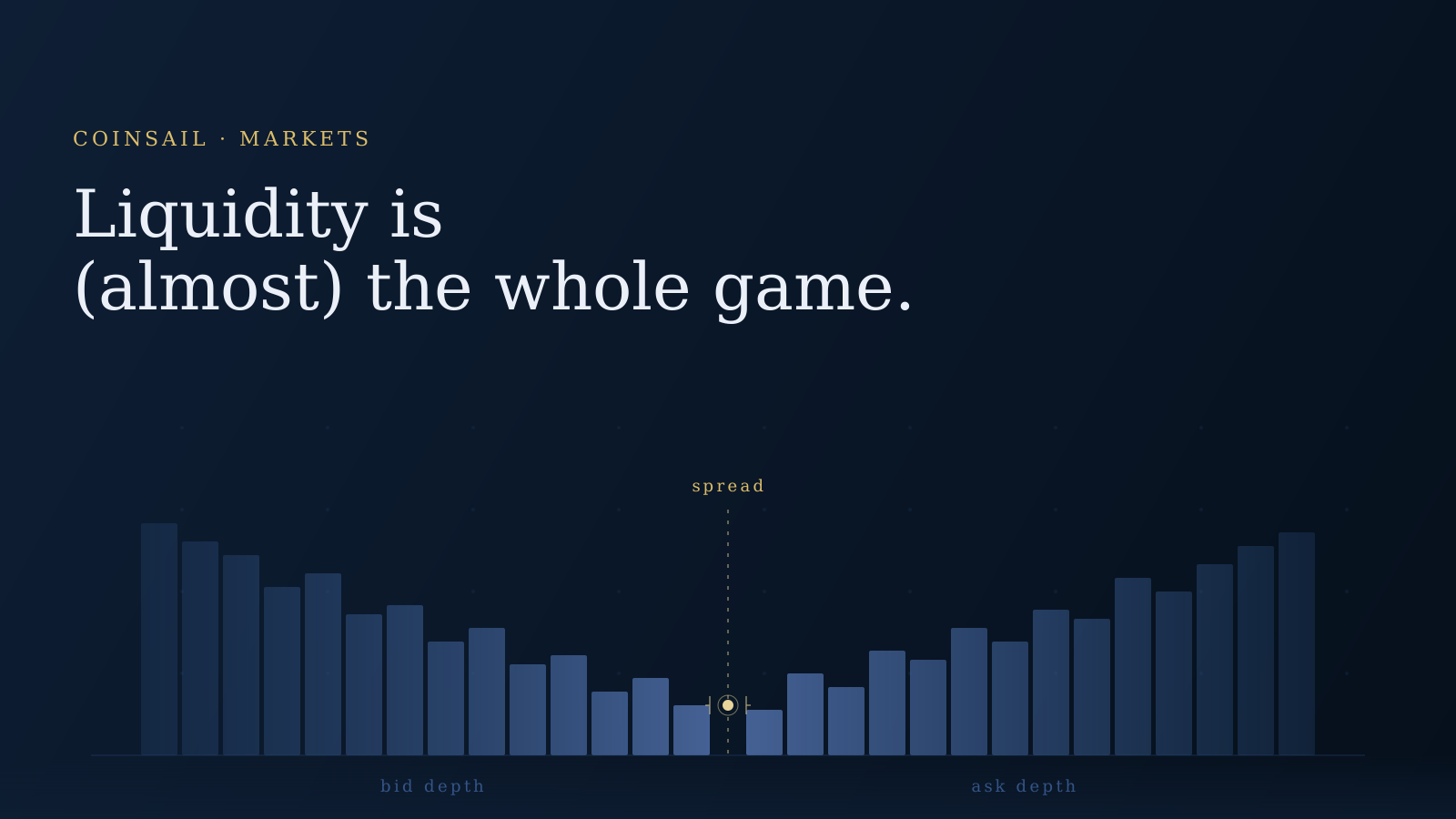
There's a reason "liquidity" gets used in the same breath as every other market explanation. When markets are liquid, you barely notice — quotes are tight, you transact near the price on the screen, and the cost of being wrong is mostly the trade itself. When markets aren't liquid, the screen price becomes optimistic. Spreads widen. Depth thins. The same trade you put on yesterday now moves prices by more. And every other read you had on the market — macro, micro, technical, fundamental — suddenly costs more to act on.
"Liquidity is (almost) the whole game" is editorial shorthand for that asymmetry. The hedge in the parenthesis is the point of this article: liquidity is enormously important, but it is context, not a direction call. Read this way, it stops being a slogan and becomes one of the cleanest reads a careful reader can have.
What market liquidity actually means
The New York Fed, in its Liberty Street Economics introduction to the topic, defines market liquidity plainly: it is "the ability to buy and sell securities quickly, at any time, at minimal cost." Each part of that sentence matters — quickly means immediacy is part of the price, at any time means it's about the conditional ability to trade rather than just past activity, and at minimal cost means the cost of the trade itself, including spread and price impact.
A more workmanlike version is offered by William C. Dudley, then the President of the Federal Reserve Bank of New York, in a 2016 BIS-hosted speech: market liquidity is "the cost — both in expense and time — of buying or selling an asset for cash." That framing is useful because it makes the trade-off explicit. You can usually get out of any position eventually. The question is at what price, and how soon.
Market liquidity vs funding liquidity
Most readers conflate two things that are related but distinct:
- Market liquidity is about the market's ability to absorb your trade without moving prices much.
- Funding liquidity, in Dudley's words, is "the ability of a financial entity to raise cash by borrowing on either an unsecured or a secured basis." It is about your or your counterparty's ability to fund a position in the first place.
In calm conditions they look like separate problems. Under stress they become the same problem. Dudley puts the link explicitly: "Although market and funding liquidity are often treated as distinct, they can be closely related. This is especially the case during a financial crisis. If funding liquidity declines because of market stress, for example, this may cause intermediaries to become less willing to provide market liquidity." And the reverse: "Declines in market liquidity, in turn, may further impair funding liquidity, creating a negative feedback dynamic."
That feedback loop is the single most important thing to understand about liquidity. The two sides reinforce each other on the way up, and they reinforce each other on the way down.
Volume is not the same as liquidity
A common confusion: high volume gets read as deep liquidity. They're related but not interchangeable.
Volume describes what did trade. Liquidity describes what would trade if you wanted to transact right now without materially moving the price. Some of the highest-volume days a market ever has are days when liquidity is at its worst — because volume is being driven by forced selling or panic buying, not by patient two-way activity. The metrics that matter for liquidity are the ones described below: how tight the spread is, how much size sits at the best prices, and how much prices move per dollar of flow. Volume on its own answers none of those questions.
How liquidity is measured in practice
The New York Fed's November 2025 Liberty Street Economics piece on Treasury market liquidity tracks three complementary metrics — and it's worth knowing these three because they generalise well beyond Treasuries:
- Bid-ask spread. "The difference between the lowest ask price and the highest bid price for a security, with a wider spread suggesting worse liquidity." Spread is the cost of immediate round-trip execution.
- Order-book depth. The size you can actually transact at the best bid or offer without walking through the book. Thinner depth means a smaller trade moves the price more.
- Price impact. How much prices move per unit of net order flow. Calculated, for instance, per $100 million in Treasury flow. Higher price impact means the market is more sensitive to incoming orders.
All three move together, and reading them as a set is more informative than reading any one in isolation. When all three are deteriorating at once, the market is genuinely getting less liquid — and not just less active.
How liquidity changes under stress
Liquidity can look plentiful for years and then collapse over days. Dudley, looking back at the 2008 cycle, observed: "During the last cycle, market liquidity was plentiful prior to the financial crisis. But, as the financial system became stressed and several large systemic firms teetered on the brink of failure, market liquidity quickly dried up." That asymmetry — slow to build, fast to disappear — is structural, not a one-off.
The structural reason has a name. In Treasury markets, in the Federal Reserve's own framing, "dealers provide immediacy in Treasury securities markets by taking long and short Treasury positions to accommodate client order flow." When client flow turns one-way, dealers absorb it onto their balance sheets. When their balance sheets get full — because regulatory capital requirements like the Supplementary Leverage Ratio bite, or because internal risk limits do — they pull back. March 2020 is the most visible recent stress episode: the Fed announced a temporary change to the SLR "amid a significant deterioration in Treasury market liquidity," which the Fed itself framed in terms of relieving pressure on dealer balance sheets intermediating those markets.
The same pattern shows up in miniature in calmer regimes. As one dated illustration, the November 2025 Liberty Street Economics piece documents a single news-event episode in April 2025: "Following tariff announcements on April 2, all three metrics worsened significantly — spreads widened, depth dropped to lowest levels since March 2023, and price impact spiked." Conditions improved after the tariffs were postponed on April 9. One headline, three metrics deteriorating in unison, then mean-reverting once the trigger was removed. The point here isn't the specific event or the current state of any market — it's the mechanism: liquidity metrics moving together in response to a stressor, and recovering when the stressor was removed.
A practical liquidity checklist
The reader's job is not to forecast liquidity — it's to read it honestly when it changes. A short checklist is enough:
- Are bid-ask spreads wider than they usually are? Compare to the recent typical band, not to a target.
- Is depth at the inside thinner than usual? Smaller resting size means the same trade moves the price more.
- Is price impact larger per unit of flow? This is the most informative of the three — it's the one that captures the cost of trading rather than the activity around it.
- Are intermediaries stretched? Dealer balance sheets, repo rates, and funding spreads are the funding side. If they're under pressure, market liquidity will be too.
These are observable, not predictive. They tell you the cost of acting on any other read you have, not whether the read is right.
Common mistakes
A few failure modes show up repeatedly:
- Equating volume with liquidity. Volume measures what changed hands. Liquidity measures what could change hands cheaply. These are different questions and the answers can disagree.
- Treating liquidity as a directional indicator. Liquidity describes how prices move per unit of flow. It does not tell you which way they will move. Mixing the two is one of the more expensive market-reading errors.
- Assuming yesterday's liquidity holds. A market that was liquid last week can become illiquid in a day. Dudley's framing on the 2008 cycle, and the Fed's framing on March 2020, both describe exactly this.
- Ignoring the funding side. The market and funding sides are linked. A view that only looks at spreads and depth is incomplete — under stress, dealer and counterparty funding is what often shifts first.
Risks and limitations
Liquidity is a description of current market conditions, not a forecast. A few honest limits worth keeping visible:
- Liquidity does not predict returns. A liquid market can produce losses. An illiquid market can produce gains. Liquidity changes the cost of acting, not the direction of the move.
- Historical patterns are tendencies, not guarantees. The 2008 cycle, March 2020, and April 2025 are all illustrations of the same pattern, but the next stress episode may look different in form even if it's the same in mechanism.
- Position sizing matters more than the read. A correct read on tight liquidity, combined with a position too large for that liquidity, is exactly how avoidable losses get realised. Liquidity-aware sizing is risk management, not edge.
Bottom line
Liquidity is "(almost) the whole game" because it sets the cost of acting on every other read. It is not the whole game because it gives you no direction — only how violently prices can move when a view turns out to be wrong. A reader who watches spread, depth, price impact, and the funding side, on a schedule, and writes their read down before the move, will catch most of the regime shifts that matter. That is not an edge. It's the absence of the most common kind of mistake.
Sources used
- NY Fed — Introduction to a Series on Market Liquidity (Liberty Street Economics, 2015) — plain-English definition of market liquidity and its role in capital allocation.
- William C. Dudley — "Market and funding liquidity: an overview" (BIS, 2016) — working definitions of market liquidity and funding liquidity, the feedback loop between them, and the historical observation that pre-crisis liquidity "quickly dried up."
- Federal Reserve Board — "Dealers' Treasury Market Intermediation and the Supplementary Leverage Ratio" (FEDS Notes, 2023) — the role of dealers in providing immediacy, and how regulatory capital constraints can shape that capacity, with the March 2020 SLR episode as the worked example.
- NY Fed — "How Has Treasury Market Liquidity Fared in 2025?" (Liberty Street Economics, Nov 2025) — the three operational metrics for measuring liquidity (bid-ask spread, depth, price impact), and the April 2025 tariff-event illustration of all three moving together.
"When liquidity is there you don't notice it. When it isn't, every read you had on the market suddenly costs more to act on."
More in this category
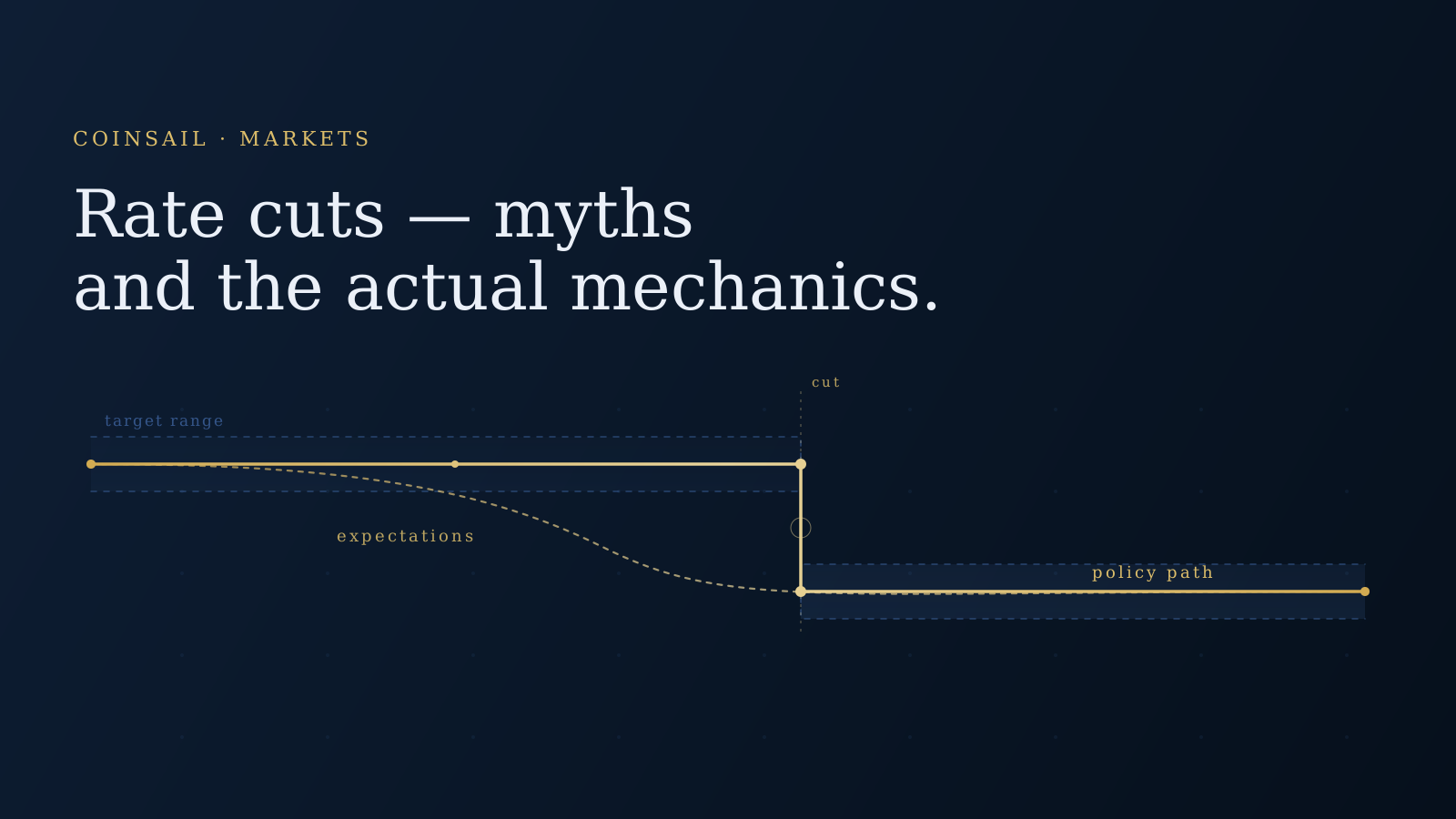
Rate-Cut Myths and the Actual Mechanics
A rate cut is a specific operational change to one overnight rate — not a global discount on every asset price. A calmer, source-backed way to read rate cuts using the Fed's own framing of how monetary policy actually transmits.
10 min read · CoinSail Editorial
Reading Markets Without the Noise
Most market commentary is noise dressed up as signal. A calmer way to read markets — anchored in how regulators and central banks actually describe volatility, financial conditions, and the data investors track.
7 min read · CoinSail Editorial